


Economy2 MIN READ
Cloudy outlook: How storms and floods affect the Philippine economy
Philippine growth and price pressures will only be worsened by the habagat the past few weeks.
September 8, 2026 by Joaquim Pantanosas
Share this article:

In what has already been a challenging year for the Philippine economy, a string of tropical cyclones and the seasonal habagat have clouded the outlook as much as they have clouded the skies.
The resulting rainfall and flooding throughout August and early September have already caused agricultural losses of up to PHP 3.6 billion, according to the Department of Agriculture (DA). This is higher than the PHP 3.5 billion in typhoon-related losses reported around the same time last year.
The DA also said that palay and high-value crop production were most affected by the rains, with estimated losses of up to PHP 1.9 billion and PHP 1.0 billion, respectively. Philippine Statistics Authority (PSA) data show that these items usually account for about 40% of the country’s total agricultural output.
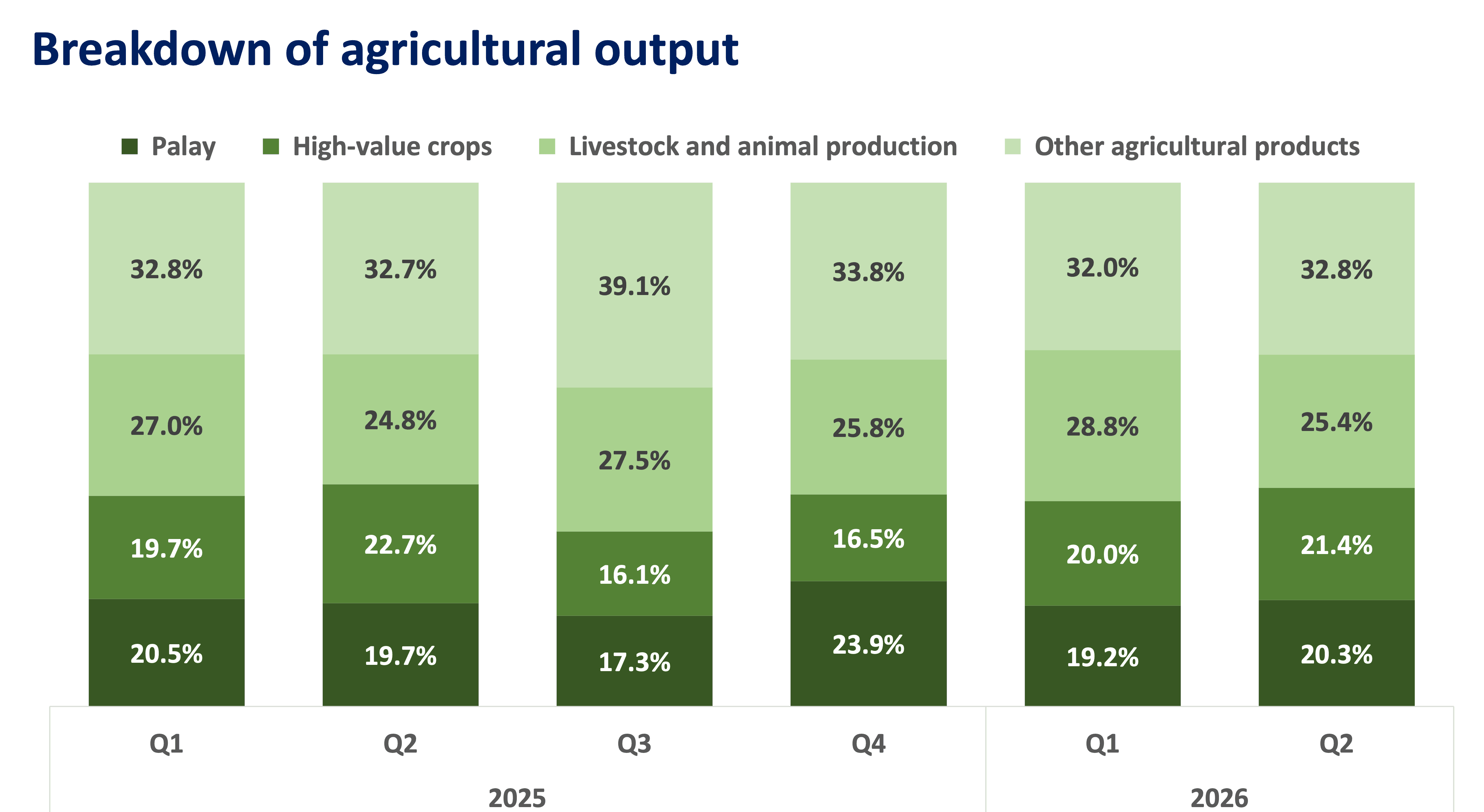
Source: Philippine Statistics Authority
The total losses may seem small relative to the sector’s total output, which stood at around PHP 448 billion in the second quarter. Furthermore, the country’s agricultural output does tend to dip in the third quarter due to seasonal rains.
Still, the sector’s growth will still be challenged by this year’s rainfall, especially when coupled with the looming Super El Niño episode, which has notably impaired agriculture growth in past instances.
The immediate effect on consumers is inflationary, as the supply shock pushes food prices upwards. This will add further upward pressure to overall inflation, as food comprises nearly 35% of the PSA’s consumer price index (CPI).
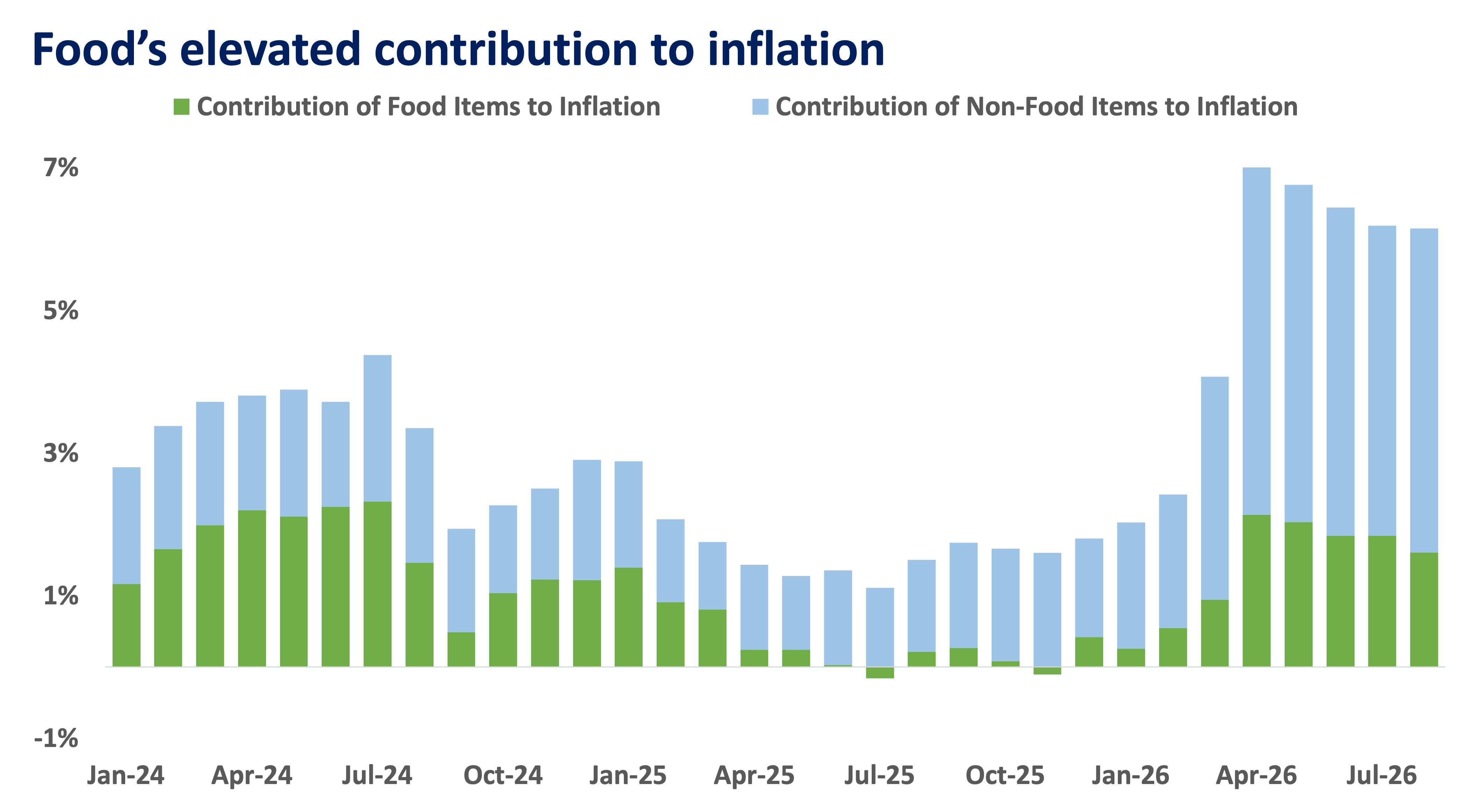
Source: Philippine Statistics Authority
In particular, prices for rice, vegetables, and fruits may be the most affected, given the extent of losses for these products.
Though the CPI tends to accelerate in the third quarter due to seasonal rainfall, the compounded effects of elevated input and transport costs may exacerbate it more than usual.
Storm-battered food inflation will also bite into overall consumption, as rising prices chip away at Filipinos’ purchasing power, keeping the economy’s main growth engine on the back foot.
In the larger picture, agriculture’s contribution to overall growth has always been modest compared to the industry and services sectors.
Still, with a fifth of the Philippine labor force working in agriculture and food accounting for the largest share of Filipinos’ consumption, intense rainfall and flooding will continue to weigh on the economy.
Even after the rainy season passes, the expected Super El Niño episode will add more inflationary pressure in the fourth quarter, when the phenomenon is expected to reach its peak. Since El Niño is a global phenomenon, the global food supply may also become more limited as countries become more protective of their own food supplies, potentially fanning inflation domestically.
Related article: Turning up the heat: El Niño likely by mid‑2026
The Philippines’ gross domestic product (GDP) growth in 2026 is expected to fall below its 3.5%-4.5% target, in part due to muted agricultural growth.
JOAQUIM “KIMI” PANTANOSAS is a Research Officer of the Macro Research Department, Markets Advisory Division, Financial Markets Sector, at Metrobank. He holds a BS in Statistics from the University of the Philippines Diliman, where he developed an interest in quantitative research as a tool for complex problem-solving. He enjoys a good laugh with the people he cares about.