Investment Tips1 MIN READ

Investment and Portfolio Management: Balancing short-term and long-term through laddering

Short-term and long-term investments have their advantages and limitations. How do you get the best of both worlds?
December 7, 2022 by Daniel Andrew Tan
Share this article:
Featured Article Image

Laddering staggers investment maturities to help investors earn long-term rates while keeping their portfolio liquid and flexible.


Is it really possible to get long-term rates with short-term investments?


Let’s find out. When considering the tenor (length of time to maturity) for a potential investment, we often ask ourselves two things: “How long before I might need the money?”, and “How much more do I gain from investing long-term versus short-term?”


The first question is rather straightforward, but is often followed by “what-ifs”. What if a good opportunity comes up? What if I’m faced with an emergency? These concerns (all very valid) tend to push us toward the shorter tenor placements. Why? Any time there is uncertainty, we want to remain liquid, hence the old adage, “Cash is king”.


The second question usually gets us to consider longer-tenor investments. That’s because under normal circumstances, long-term investments will outperform short-term placements. The higher interest rates are meant to compensate for the added risks of locking in longer.


So, how do we get long-term rates while keeping our portfolio relatively liquid? It's a question that sits at the heart of investment and portfolio management, and the answer may be simpler than you think. 
 

The right strategy: A balance of short and long-term investments

We can do that through an investment strategy called “laddering”, where maturities are staggered across different periods in the future. 


What is “laddering”?


Laddering is an investment strategy where you divide your capital across multiple fixed-income securities with different maturity dates. Instead of committing everything to a single placement, you stagger your investments so that a portion matures at regular intervals. This gives you access to your funds periodically — without sacrificing the higher yields that longer-term placements offer.


Beyond structuring timelines, laddering helps clarify where to invest next, as each maturing placement presents a fresh opportunity to reinvest at prevailing rates or shift funds as circumstances change. For example, instead of investing in a single 5-year security, we can instead invest in three different securities maturing in 4, 5, and 6 years from now.


To illustrate: if you invest PHP100,000 each into securities maturing in 4, 5, and 6 years, you effectively hold a PHP300,000 portfolio with staggered exits. Each maturity returns both principal and interest, which you can reinvest at the long end — keeping the ladder intact and yields consistently high. 


This gives us almost equivalent interest rates while also adding liquidity and flexibility to our portfolio. In three years’ time, we will effectively have annual investment maturities that are giving 5-year rates.


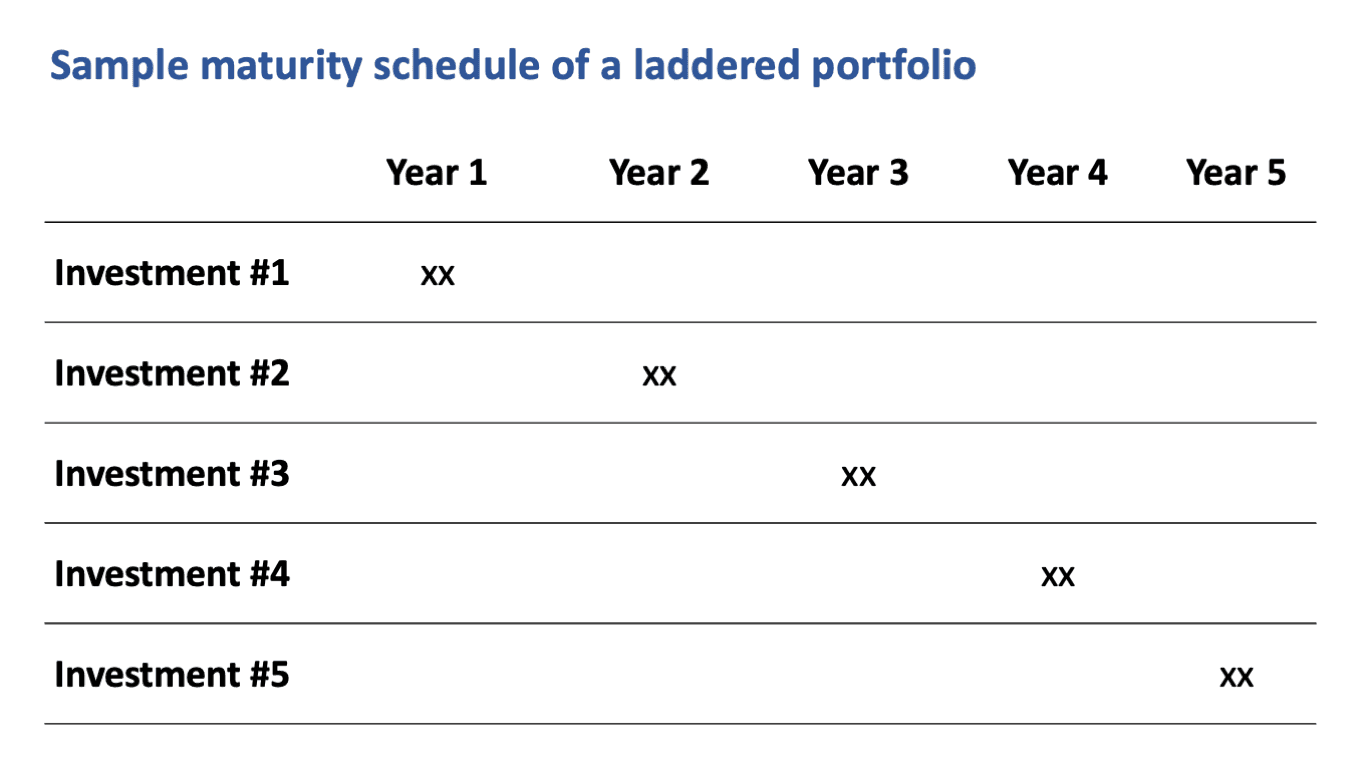
Do this frequently enough, and our portfolio should look like this:
 

“Laddering” can be used to schedule the maturities of your investments over time, balancing returns with flexibility and liquidity.

It looks plain enough, but assume we booked all of the investments 4 years prior. Then the year 1 maturity should be giving 5-year rates, year 2 gives 6-year rates and so on. Furthermore, the portfolio has maturities each year, giving the option of reinvesting (ideally in the long end to keep yields high) or utilizing the funds elsewhere as needed. 


These are the main advantages of adopting this strategy—and why laddering is widely used as a model portfolio approach in long-term investment planning. 
 

The trade-offs of ladderin

It all looks good, but laddering also has some trade-offs. It requires a higher overall investment capital than you would otherwise need, since each placement will need to clear minimum investment requirements depending on the type of security. This makes it either difficult to implement in full, or entails a gradual build-up over time.


Secondly, laddering also requires sufficient planning before it can be properly implemented. It involves timing placements according to one’s needs as well as the interest rate environment at the time of placement. While it offers significant yield benefits, it requires a more active approach than some may prefer.


Despite these trade-offs, laddering remains a practical and rewarding strategy for most fixed income investors. The capital and planning requirements are real, but manageable—and the long-term benefits of consistent yields, regular maturities, and built-in flexibility make the effort well worth it.
 

Practical Investment Management for the Long-Term Investor

Bottomline: Laddering is definitely a viable approach to enhancing your fixed income portfolio. As a portfolio investment strategy, it works best when rates are already high—making that the ideal time to start. 


Plan out your maturities according to projected funding requirements first, then just spread out your placements to maintain flexibility and enhance yields. Each maturing placement also opens up a new investment option—giving you the choice to reinvest at current rates or redirect funds where they're needed most. 


As a general guideline, keep maturities short in a rising rate environment, and tranche in longer as rates peak and start to fall.
 

DANIEL ANDREW TAN is a Relationship Manager for Metrobank’s Private Wealth Division, whose function mainly involves providing investment and wealth management advice to the Ultra-High-Net-Worth Individuals (UHNWI). He brings with him over fifteen years of experience in both retail banking and financial markets, and he avidly monitors Philippine equities. He applies both active and passive investment strategies to his personal portfolio and strongly advocates for a “tailored” approach to investments.

Frequently asked questions

How many "rungs" should my ladder have?


There's no fixed number, but most ladders have between three and five placements. More rungs offer greater flexibility, though each additional placement increases the capital required.


Does laddering work in a low-interest-rate environment?


It can still provide structure and liquidity, but the yield benefits are less pronounced. In a low-rate environment, shorter maturities are generally preferred until rates begin to rise.


Is laddering suitable for beginner investors?


Laddering is a straightforward investment management concept but requires planning and sufficient capital to execute. Beginners may benefit from consulting a financial advisor before building their first ladder.


Can I build a ladder gradually?


Yes. If full implementation isn't immediately feasible, you can build your ladder over time. Start with one or two placements, then add new rungs as capital becomes available, gradually working toward a fully staggered portfolio with annual maturities.